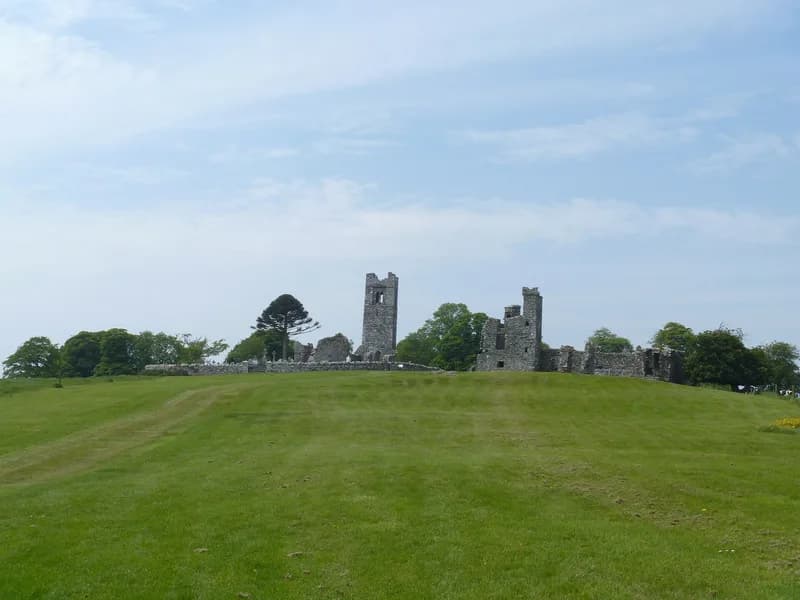
The Hill of Slane: what is up there, and how to see it
The free, always-open side of Slane: the 1512 friary and college on the Hill, the Fleming motte, the legend of Patrick's fire, and how to fit it into a day.
There are two big sights in the Slane story and only one of them is open every day of the year for nothing. The castle sits down by the river behind its walls and opens by appointment. The Hill of Slane is the high ground north of the village, off the N2 Collon road, and you can walk up it whenever you like. If you have one hour in Slane and no booking anywhere, this is where it goes.
Getting up there
From the Square, the Hill is under a kilometre north as the crow flies, up Chapel Street and on along the Collon road. There is a small car park at the foot. Go through the gate and walk up across the grass to the ruins. It is not a climb in the mountain sense, but it is open ground, often wet, and it catches every bit of wind that the village below is sheltered from. Proper shoes, and a layer more than you think.
The Slane Historic Trail, the village's own plaque-and-panel walk, lists the Hill as its final stop and marks it as one to reach by car, which is honest: walking up the Collon road on the verge of a national route is not pleasant. Drive up, or walk the village first and drive the last stretch.
What is on top
The building you see from miles around is the tower of the Franciscan friary church. The Flemings, the family who were barons of Slane from the Norman period into the seventeenth century, founded the friary in 1512. Beside it stands the shell of the college they built at the same time to house four priests, four lay brothers and four choristers, and their coat of arms is still on the west wall of the college quadrangle. The friary did not last long in its first form: Henry VIII dissolved it about thirty years after it was founded. The Flemings restored it in 1631 and brought in Capuchin friars, who were driven out in 1651 by Cromwell's forces.
Walk round to the western side of the hill for the oldest thing up here that you can actually point to: the remains of the Flemings' motte, the earthwork castle mound they threw up in the twelfth century, long before the friary. The graveyard around the church has newer headstones among the old ones, so treat it as a graveyard and not a picnic spot.
The fire, and what to make of it
Everyone who comes up here comes for the story. In the tradition, Patrick lit the Paschal fire on this hill at Easter, in defiance of the High King at Tara, who was preparing the pagan festival fire of his own. A monastery is said to have been founded here afterwards by St Erc, one of Patrick's followers, and the 1512 friary was built on its site.
None of that is history in the way the 1512 date is history. It is legend, and it is worth taking as exactly that. What the hill does give you is the reason the legend chose it. Stand by the tower on a clear day and the land opens out below: the Boyne valley, the fields running east toward Drogheda, and on the right day the Hill of Tara. A fire up here would have been seen.
A guided walk, if one is running
A volunteer group, Hill of Slane Tours, has run free 40-minute guided walks on the Hill every Sunday from April to October at 2pm, meeting at the gates, and takes group bookings at other times through the Slane Hub. The listing for the tours carries no year, so before you build a Sunday around one, ring the Slane Hub on +353 41 982 4000. The Hub, at 2 Main Street, is open on weekdays and is also the place to pick up the historic trail map.
When to go
Any time. It is free, there is no ticket desk, and nothing needs booking. Early morning and evening are the quiet times. Easter is the obvious date, given the story. A clear frosty morning in winter is the best one for the view. On the weekend of a castle concert the village below will be a different place, but the Hill is still the Hill.
Putting it in a day
The Hill pairs naturally with the village walk: an hour on the historic trail from the Square, down Mill Hill to the river at Slane Mill and back, then up to the Hill, then lunch at the Conyngham Arms, which serves from noon seven days a week, or at Silly Sid's in the Village Inn until 4pm. If you have a Newgrange slot booked at Donore, do the Hill first thing in the morning, since the visitor centre is a short drive east and the tours run to a timetable that will not wait for you.
Keep Reading
Slane Castle without a concert ticket: the ways in, and what they cost
Since 2024 Slane Castle has opened by appointment only. Here are the three ways in, private tours, Heritage Week and ticketed events, plus the concerts and the distillery next door.
PlanningNewgrange from Slane: the Donore rule, the booking windows and the right tour
Newgrange is close to Slane but you cannot drive to it. How the Brú na Bóinne Visitor Centre at Donore works, when tickets are released, which tour to pick, and how to build the day from the village.
Planning a trip?
Explore restaurants, activities, accommodation, and more.