About Castlebar
The history, geography, and character of Castlebar.
History & Heritage
From the de Barra castle to the linen town
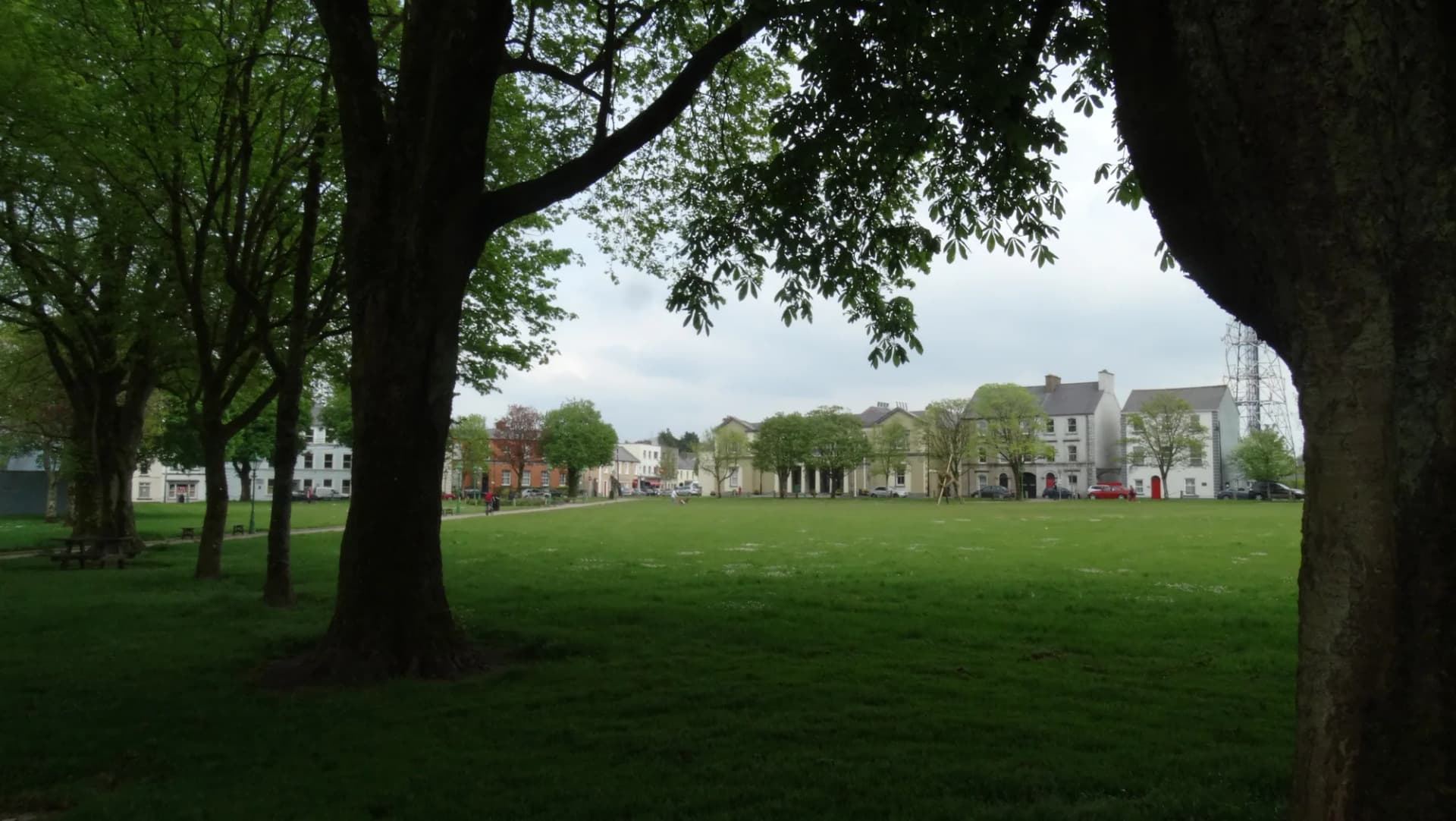
Castlebar takes its name from a castle built by the de Barra (Barry) family, the Caisleán an Bharraigh that gives the town its Irish name. By the early 1600s the lands had passed to the Bingham family, later the Earls of Lucan, who would dominate the town for centuries. The Binghams shaped the modern street pattern, and the Mall, the long green at the centre of town, was originally the family's cricket pitch before the 4th Earl of Lucan gave it to the people of Castlebar in 1888. The town's character was changed again in the 1770s, when planters were brought in from Ulster to develop flax growing and the linen trade. The street names in this part of town still carry that history. The Linen Hall, a handsome Italianate trading house commissioned by Charles Bingham, 1st Earl of Lucan, was completed in 1790 as a clearing house where merchants bought and sold local linen. That same building serves the town today as the Linenhall Arts Centre.
The Races of Castlebar, 1798
On 22 August 1798, around 1,100 French troops under General Jean Joseph Amable Humbert landed in County Mayo to support the United Irishmen against British rule. Five days later, on 27 August, Humbert's combined force of roughly 800 French soldiers and some 2,000 Irish rebels met a much larger British army of around 3,000 to 4,000 men under General Gerard Lake at Castlebar. Guided by locals along a route west of Lough Conn that the British thought impassable for an army with artillery, the French and Irish appeared from an unexpected direction. The British militia broke and fled so quickly that the engagement was forever after known with grim humour as the Races of Castlebar. Thomas Pakenham, in The Year of Liberty, called it one of the most ignominious defeats in British military history. John Moore, a young local man and brother of a landowner, was declared President of the Province of Connacht in the brief Republic that followed. The rising was short-lived, and Humbert surrendered after defeat at Ballinamuck in September. Moore died not long after; his remains lie today in a corner of the Mall, marked by the 1798 monument that was erected on the 150th anniversary of the rising. Castlebar still marks the events every August with its 1798 Festival.
The word that Mayo gave the world
A short drive south of Castlebar, near Lough Mask, the English language gained a new word in the autumn of 1880. Captain Charles Cunningham Boycott was an English land agent managing the Lough Mask estate of Lord Erne. After a poor harvest he refused to lower rents, and following Charles Stewart Parnell's call for tenants to shun rather than attack such men, the local community simply stopped dealing with him. Labourers withdrew their work, the blacksmith and postman and laundress would not serve him, and shops in nearby Ballinrobe turned him away. The campaign drew national and international attention, and by November 1880 The Times of London was using his name as a verb. Within twenty years boycott had entered dictionaries around the world. It remains one of County Mayo's more unexpected gifts to the world, and a reminder of how hard-fought the Land War was in this corner of the west.
Mayo GAA and the modern county town
If there is one thing that binds Castlebar and the whole county together, it is Mayo GAA. The county's home ground, MacHale Park in Castlebar, is the largest stadium in Connacht, and on big championship days the town fills with green and red. Mayo last won the All-Ireland Senior Football title in 1951, and the long wait since has become part of the county's identity, carried with a stubborn loyalty that locals will explain to you whether you ask or not. The team has reached and lost numerous finals in the decades since, the longest such sequence in the history of the championship. Beyond the football, Castlebar is the administrative heart of Mayo, seat of the county council, and a busy retail and services town. It has a lively food and arts scene for its size, anchored by the Linenhall Arts Centre and a clutch of independent restaurants, cafés and producers. The greenway out to Turlough, the lakeside walks at Lough Lannagh, and the National Museum of Country Life all sit within easy reach, and Westport, Clew Bay and Croagh Patrick are less than half an hour to the west.
Wildlife & Nature
Birdlife
Mute Swan
Large white swan seen year-round on the Mall lake and Lough Lannagh.
Year-round
Mallard
Familiar duck found on the Mall lake and Lough Lannagh throughout the year.
Year-round
Grey Heron
Tall wading bird that hunts along the waterways at Lough Lannagh and the Mall.
Year-round
Little Grebe
Small diving bird that breeds on sheltered stretches of Lough Lannagh.
Spring to autumn
Flora
mature beech and lime on the Mall
The Mall's avenue of mature beech and lime trees forms one of Castlebar's most recognisable streetscapes.
Spring and summer for full leaf
reed beds at Lough Lannagh
Extensive reed beds border Lough Lannagh, providing nesting habitat for waterfowl.
Year-round
oak and birch woodland at Turlough Park
Native woodland at Turlough Park surrounds the National Museum, managed for biodiversity.
Spring and summer