About Dunfanaghy
The history, geography, and character of Dunfanaghy.
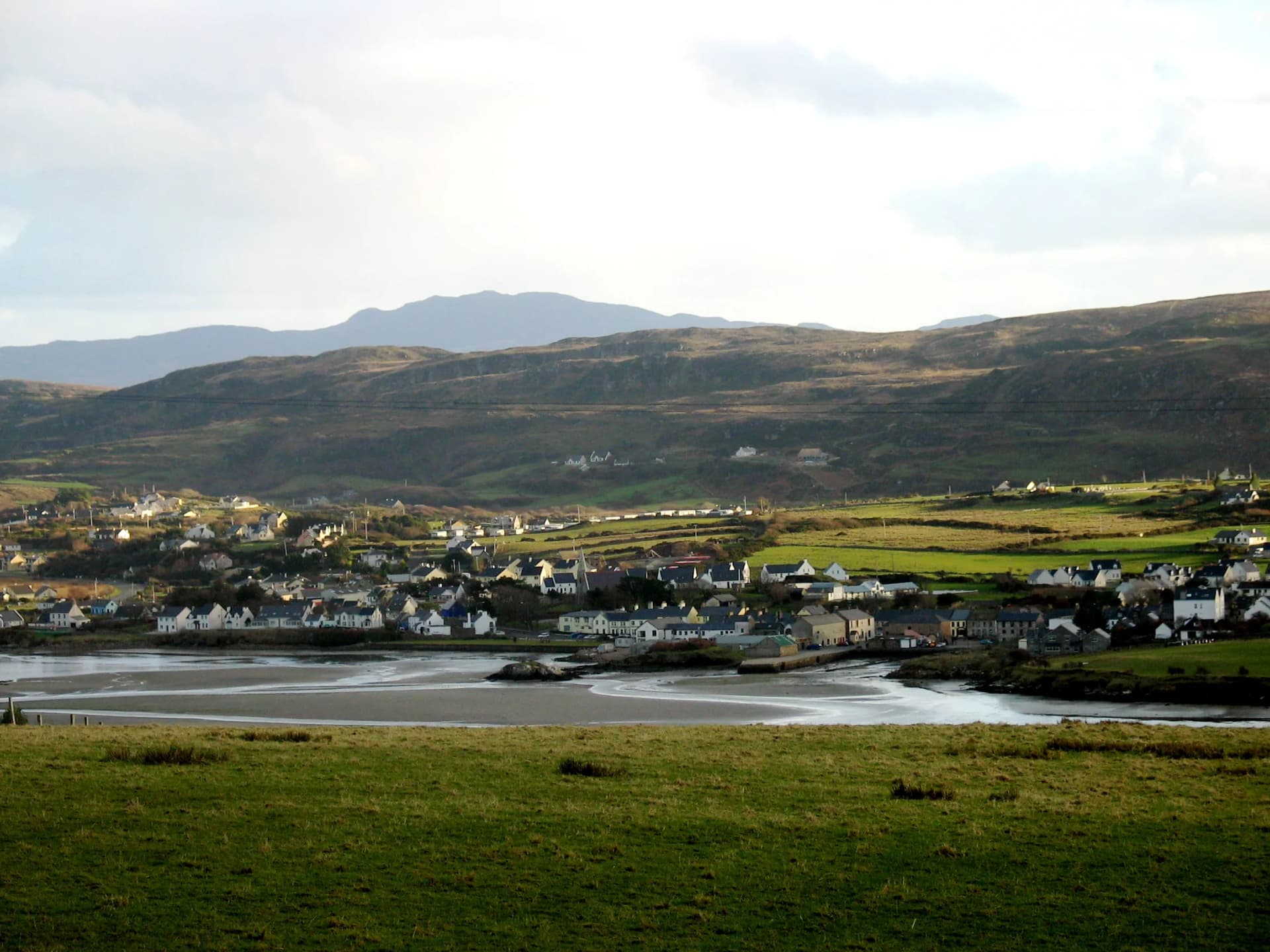
Dunfanaghy, Dún Fionnachaidh in Irish, is a village of one main street, a square and a harbour at the head of a small bay off Sheephaven, on the N56 in north-west Donegal. Horn Head, Corrán Binne, fills the view to the north; Muckish, An Mhucais, sits flat-topped to the south; and within a few kilometres in either direction there are three big strands, a forest park, a MacSweeney castle and the ferry pier for Tory. It is a holiday village in summer and a quiet one in winter, and the Cloughaneely Gaeltacht begins a short drive to the west.
History & Heritage
The village and its neighbours
The village runs along Main Street from Arnolds Hotel to the Square, where the coaches stop beside Market House and the old pier, and on west past the churches to the Workhouse. Most of what a visitor needs is within a fifteen-minute walk of the Square, including Killahoey strand and the dune path to Tramore Beach under Horn Head. Port na Bláiche, Portnablagh on the road signs, is the small harbour village about three kilometres east, with Marble Hill strand beyond it. West along the N56 is Cloich Cheann Fhaola, the Cloughaneely Gaeltacht around An Fál Carrach and Gort an Choirce: Údarás na Gaeltachta counts 4,042 people in that language planning area and 39.6 per cent of those aged three and over speaking Irish every day outside education. Place names on the signs change accordingly, and Magheroarty, where the Tory ferry sails, is Machaire Uí Rabhartaigh.
The workhouse
The Dunfanaghy workhouse opened on 24 June 1845, one of eight in Co. Donegal, for a Poor Law Union whose area included Dunfanaghy, Creeslough, Derryreel, Falcarragh and Derryveagh. Only five people were admitted at first. By 1847 the building had been extended, and by 1851 it held 481 people. It closed in 1918, was later used as a co-operative and a store, was declared a heritage site in 1989 and reopened in 1995 as a Famine heritage centre, 150 years after it first opened. Its exhibition is built around Wee Hannah Herrity, a local woman who survived those years and later told her story in her own words, and it is now also the village's tourist information point and the start of the Heritage Trail.
Horn Head and the Stewarts
For two centuries Horn Head belonged to the Stewarts, the local landlords, who bought the estate in 1700 and lived at Hornhead House, the big house you pass among the trees on the way onto the head; the family left in 1922. The Workhouse's own local-history writing credits them with Hornhead Bridge, built in 1809, before which the usual way off the head was across the strand. The same account tells how, during the First World War, the marram grass on the dunes was cut and sent to France as bedding for horses, and how the storm of 1917 then blew the unprotected sand across the bar and the bridge and left the lake behind it, which is still called the New Lake, An Loch Úr. Today the lake and the dunes are part of a protected site for wintering geese.
The strands
Killahoey, Trá na Cille, is the village strand, and Marble Hill is the bigger beach east of Port na Bláiche; Donegal County Council lists both among its Blue Flag beaches for 2026, with lifeguards from June to mid-September. Tramore Beach under Horn Head has no road and no lifeguards and is reached on foot through the Lurgabrack dunes. At low tide on Killahoey the remains of the Dinas, a steam trawler that stranded in 1937, sometimes show through the sand. Do not confuse this Tramore with Tramore in Co. Waterford, or with the other Donegal beaches of the same name.
Doe Castle and the MacSweeneys
Across Sheephaven Bay, on an inlet between Creeslough and Carrigart, Doe Castle was the stronghold of the MacSweeneys, built in the 1420s according to the Office of Public Works. At least thirteen MacSweeney chiefs held it; one sheltered survivors of the Spanish Armada in 1588, and the last marched out with Red Hugh O'Donnell to Kinsale in 1601. The grounds are free and open every day.
Wildlife & Nature
Marine Life
Grey seal
One of the species the Horn Head and Rinclevan Special Area of Conservation is designated for, per the NPWS site synopsis. Look along the rocks of the bay and the foot of the head.
All year
Birdlife
Razorbill, guillemot, kittiwake, fulmar and puffin
The cliffs of Horn Head hold one of the main breeding seabird colonies in the Horn Head to Fanad Head Special Protection Area. The NPWS synopsis records nationally important numbers of fulmar, kittiwake, guillemot and razorbill, and a smaller number of puffins.
Late spring and early summer
Chough
The red-billed crow of the cliff tops. The NPWS counted 29 breeding pairs across the Horn Head to Fanad Head Special Protection Area in its 2002 to 2003 survey, an internationally important population.
All year
Peregrine falcon
Breeds on the Horn Head cliffs. The NPWS rates the Horn Head to Fanad Head Special Protection Area of high importance for the peregrine and the chough alike.
All year
Greenland white-fronted and barnacle geese
Nationally important flocks winter on New Lake, Rinclevan and the dunes west-south-west of the village, feeding on the dune grassland, according to the NPWS. Whooper swans come in too.
Late autumn to early spring
Flora
Thrift, sea campion and rock samphire
The maritime plants that the NPWS records on the ledges of the Horn Head cliffs, where soil has built up on the quartzite.
Late spring and summer
Fixed-dune grassland at Lurgabrack
Red fescue, marram and lady's bedstraw with red clover, bird's-foot-trefoil and pansy, and the nationally scarce lesser meadow-rue, on the fixed dunes north-east of the village and around Tramore Beach, Horn Head, per the NPWS.
Summer