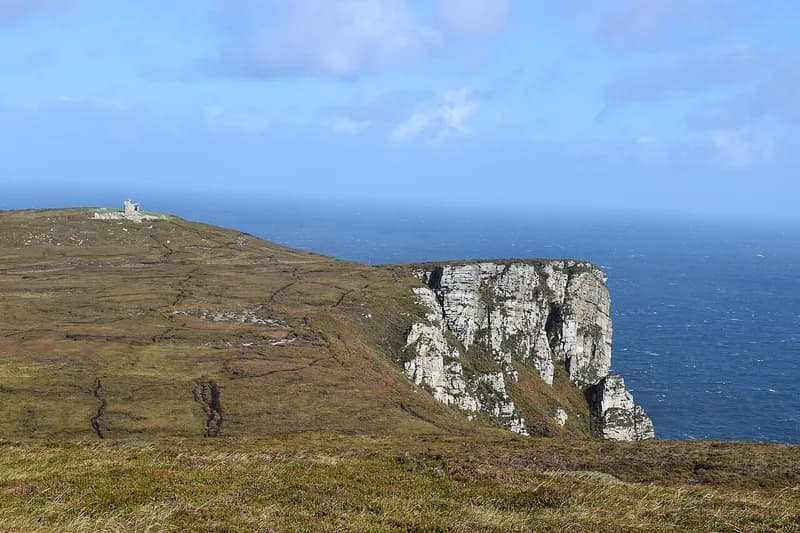
Horn Head: the drive, the walk to the signal tower, and when not to go
How to get onto Horn Head from Dunfanaghy, what the road is like, the walk from the coastguard station to the signal tower, and the weather and cliff-edge rules that matter more than anything else.
Horn Head is the reason most people stop in Dunfanaghy rather than drive through it. It is the big headland across the bay to the north, Corrán Binne in Irish, and from the Square it looks close enough to walk to. You can walk to it, but most people drive the road onto it and then walk the last part, and that is the plan this guide follows.
What is out there
The north side of the head is a line of quartzite sea cliffs. The National Parks and Wildlife Service, which protects the headland as the Horn Head and Rinclevan Special Area of Conservation, puts their maximum height at 207 metres. The cliffs are a seabird colony: razorbills, guillemots, kittiwakes, fulmars and shags, and a smaller number of puffins, with choughs and peregrines breeding too. Inland of the cliffs it is heather and bog. There are no shops, no café and no toilets anywhere on the head, so go with what you need.
The road
The Horn Head road leaves the N56 at Hornhead Bridge on the western edge of the village, beside the start of the dune path to Tramore Beach at Lurgabrack. The bridge itself was built in 1809, according to the Workhouse's own local-history writing; before that the way off the head was across the strand. From the bridge the road climbs onto open ground and loops round the head, with two places to stop that matter:
- The seabird viewing point on the eastern side, with an information board, looking down the coast and back over Sheephaven Bay to the village and to Muckish.
- The small car park by the ruined coastguard station, further north, under Coastguard Hill, which is where the walk starts.
The road is narrow, single-track for stretches, with few passing places, and it is not a road for coaches or big campervans. Drive it slowly, pull in for oncoming cars, and do not stop on the bends for a photograph.
The walk to the signal tower
From the coastguard station car park a path heads north over the moor to the old stone signal tower and on to viewpoints at the northern tip. On the mapped path it is about 1.5 kilometres each way, so about three kilometres there and back, and most people take an hour to an hour and a half with time at the top. There is very little climbing. What there is instead is wet ground: the moor between the car park and the tower holds water for most of the year, and the path fades in places, so boots are worth more than a good jacket here. The full route, with waypoints, is in our trails section.
The rules that matter
Horn Head is not a dangerous place on a clear, calm day if you keep to a few rules. It becomes one quickly when you do not.
- Stay well back from the edge. The cliff tops are open moorland with no fence, and the drop is to the sea.
- Turn back in mist. Cloud comes in off the Atlantic fast. When the head is in mist you will see nothing, the faint path gets harder to follow, and the cliff edge is somewhere nearby. If cloud starts to come down, go back the way you came.
- Wind. On a day when the bay is full of whitecaps, the top of the head is not the place to be with children.
- No dogs from September to April. The Horn Head trail listing on Sport Ireland bars dogs from 1 September to 30 April and wants them on a lead from 1 May to 31 August, when the birds are nesting.
- Leave the seabirds alone in late spring and early summer, when the colony is breeding. Watch from the top.
- In an emergency, dial 112 or 999 and ask for the Coast Guard. Before you set out, tell someone where you are going.
When to go
A dry, clear day from late spring to early autumn is the ideal; the seabirds are on the cliffs from late spring into summer. Check the cloud base from the Square before you set off: if the top of the head is in cloud from the village, it will be in cloud when you get there. In winter the drive is still worth doing on a bright day, but the walk is wetter and the light goes by late afternoon.
Combining it
The obvious pairing is Tramore Beach, Horn Head, the Atlantic strand on the western side of the neck of the head, which has no road and is reached on foot through the Lurgabrack dunes from near the start of the Horn Head road. Do one in the morning and the other in the afternoon. If the weather turns, the Workhouse on the way back into the village is the best indoor hour in Dunfanaghy.
Keep Reading
Killahoey, Marble Hill and Tramore Beach, Horn Head: which Dunfanaghy strand for what
The three big beaches around Dunfanaghy are very different places. Which ones have lifeguards, which is the surf school's beach, which one you have to walk to, and where else to get in the water.
History & CultureA wet day in Dunfanaghy: the Workhouse, the Heritage Trail and Doe Castle
What to do in Dunfanaghy when it rains: the 1845 workhouse and Wee Hannah Herrity's story, the ten-stop audio trail through the village, the Stewarts of Horn Head, and the MacSweeney castle across the bay.
Planning a trip?
Explore restaurants, activities, accommodation, and more.