About Lismore
The history, geography, and character of Lismore.
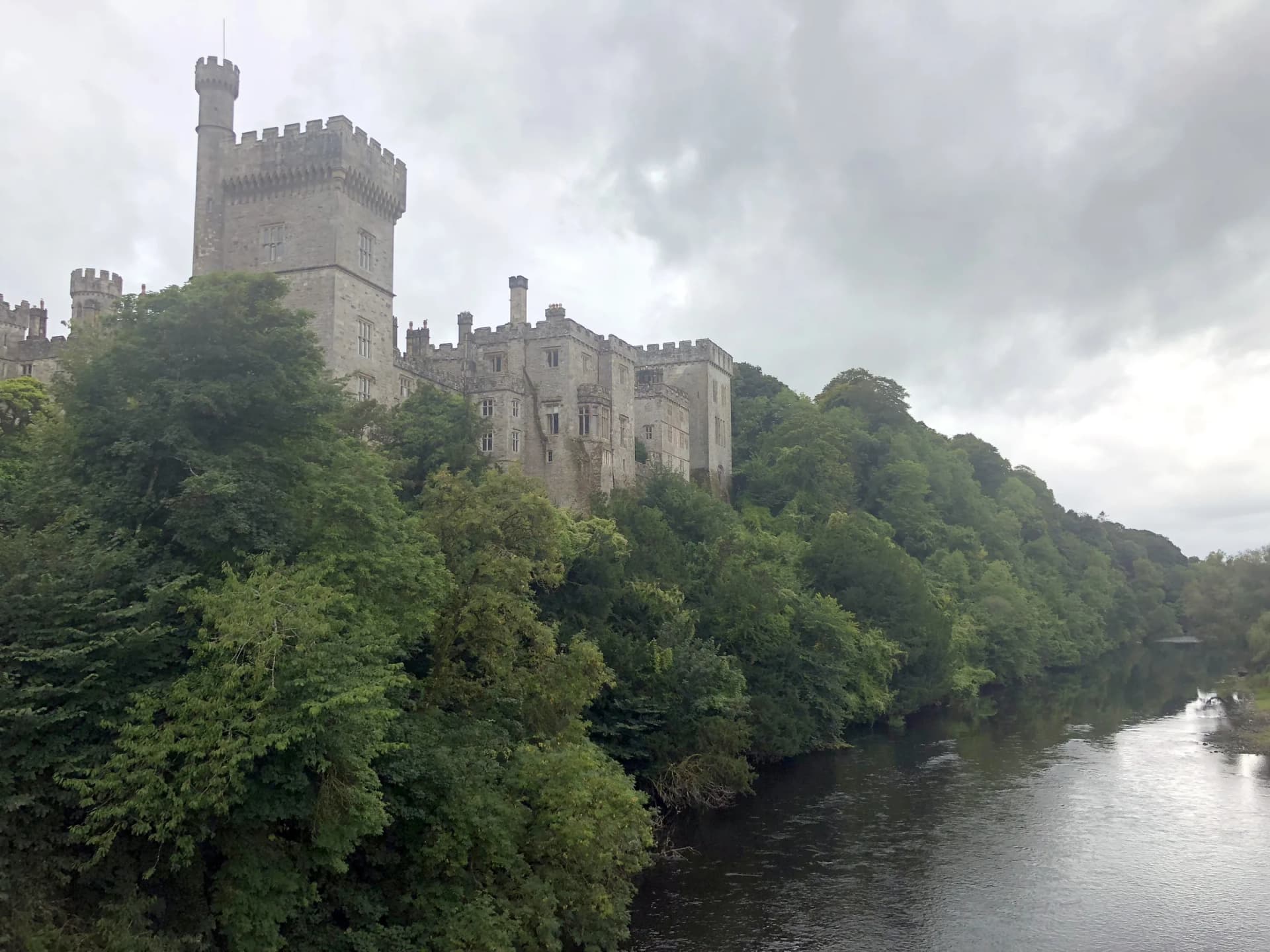
Lismore is a small heritage town in west Waterford, on the south bank of the Munster Blackwater where the N72 crosses the river, about 25km inland from Dungarvan. Its name is Lios Mór, the great fort. The town grew out of the monastery Carthage founded here in 636, and it was laid out in its present shape by the Dukes of Devonshire, whose castle stands on the rock above the bridge. Most visitors come for that castle and find they can see the gardens and the gallery but not the house. The town is worth the trip on its own terms: a Church of Ireland cathedral with a Burne-Jones window, a courthouse turned heritage centre, a river walk, and the road north over the Knockmealdowns.
History & Heritage
Lios Mór and the monks
Carthage came here in 636, and Lismore became one of the great monastic schools of early Ireland; the Heritage Centre's history has Irish high kings learning from its saints and scholars. The 'great fort' of the name is generally taken to be the earthwork at Round Hill by the river, where local tradition puts his first enclosure. Very little of the monastic town survives above ground, but the cathedral keeps a set of inscribed stones found during work on its spire in 1827, carrying prayers for abbots and bishops of the ninth and tenth centuries, among them Suibne, a hermit and later abbot who died in 854.
From King John to the Dukes
The first castle was built for King John in 1185 to guard the crossing. The Heritage Centre's short history runs from there through Sir Walter Raleigh, who held it and sold it to Richard Boyle, later the 1st Earl of Cork, to the Cavendish family, Dukes of Devonshire, who came by it through marriage and rebuilt it into the turreted house seen from the bridge today. Boyle laid out the upper garden in about 1605; the 6th Duke had the lower garden made in the nineteenth century. The house is still the family's Irish home and is not open to visitors. The Book of Lismore and the Lismore Crozier were found hidden in its walls, where, the Heritage Centre says, they had lain for almost two centuries.
A scientist and a dancer
Two names come up in every conversation about the castle, and both check out. Robert Boyle, the experimental scientist remembered for Boyle's law, was the Earl of Cork's son, and the Royal Society records him as born at Lismore Castle on 25 January 1627; the Heritage Centre's virtual tour is narrated in his voice. Three centuries later Adele Astaire, Fred Astaire's sister and dancing partner, married Lord Charles Cavendish, the 9th Duke's second son, in 1932, and the couple made Lismore Castle their home. Fred came to visit. Lord Charles died at the castle in 1944 and is buried at the cathedral.
The river
The Blackwater runs east past the castle and under Lismore Bridge on its way to Cappoquin, about 7km downstream by road, where it turns south for the sea at Youghal. It is a salmon river first: the riverbank walks pass fishing stands and stiles, and the beats below the castle are fished by permit. Anglers need a state licence from Inland Fisheries Ireland, and the rules on what can be kept change, so check the current bye-laws before you fish. The river floods after heavy rain, and the Riverside Walk closes when it does.
Wildlife & Nature
Marine Life
Atlantic salmon
The fish the Blackwater at Lismore is known for. Fishing stands along the riverbank walks mark the salmon beats.
Spring and summer runs; check Inland Fisheries Ireland for the season
Birdlife
Grey heron
Listed by Discover Ireland among the water birds of the Riverside Walk, standing in the shallows below the town.
All year
Kingfisher
Also on Discover Ireland's list for the Riverside Walk; a flash of blue low over the water is usually all you get.
All year
Mute swan
Swans are on Discover Ireland's list for the Riverside Walk too, on the open water below the town.
All year
Flora
Wild garlic
Carpets the riverbank woodland on Lady Louisa's Walk, alongside wood sorrel and golden saxifrage.
April and May
Beech and ash woodland
The canopy over Lady Louisa's Walk, with holly, ivy and spindle tree beneath.
Spring for new leaf, October for colour
Rhododendron
Planted along the old avenue at Ballysaggartmore and spread wild over the slopes of the Vee, where the Geograph record of the Vee road calls it a major problem.
Flowers in late spring