About Carrigaline
The history, geography, and character of Carrigaline.
History & Heritage
The castle, the river, and the old village
Carrigaline grew up around its castle, a tower built on a rock above the Owenabue by the Norman de Cogan family. The building was probably begun by Milo de Cogan around 1180 and finished in the 1190s. Over the medieval centuries it passed through powerful hands: the Earls of Desmond acquired it in 1438, the Fitzmaurice Fitzgeralds leased it, and in 1568 it was granted to the English planter Warham St Leger, a transfer that helped trigger the Desmond rebellions. By the early seventeenth century it had passed to Daniel Gookin of Kent, and not long after it was abandoned. The original village sat right beside the castle; in the eighteenth century the settlement moved downhill to cluster around the bridge over the Owenabue, which is where the town centre still stands today. The castle ruin survives east of the town, though it has been steadily robbed for stone and a large section collapsed in 1986, so it is admired from a distance rather than visited. The Owenabue itself, Abhainn Buí or the yellow river in Irish, rises north of Crossbarry and runs roughly thirty kilometres east through Ballea Woods and into Carrigaline before going tidal.
Drake's Pool: history or a good story?
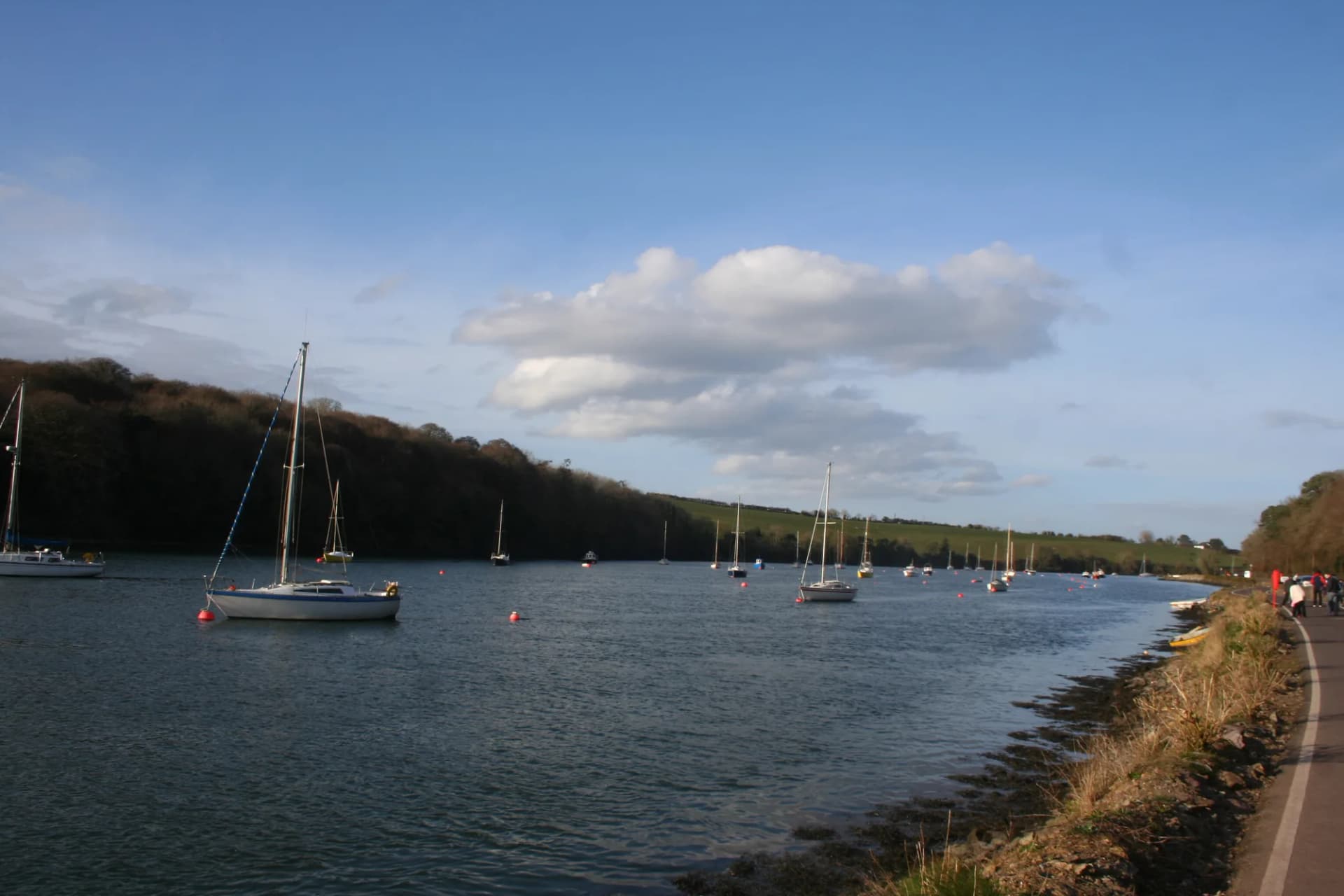
A mile or so downriver from the town the Owenabue opens into a deep, sheltered basin called Drake's Pool, a popular anchorage to this day. The name comes from a piece of local tradition: the story goes that Sir Francis Drake slipped a small squadron of English ships up the estuary and hid them behind Currabinny hill to escape a larger Spanish fleet pursuing him into Cork Harbour. It is a great yarn, and it is worth being honest about it. There is no contemporary evidence for the episode. The earliest written version comes from Charles Smith's history of Cork in 1750, who dated it to 1589, after the Armada; the naval historian Julian Corbett argued in 1890 that if it happened at all it could only have been during the Earl of Essex's campaign of 1573 to 1575. In other words, the Drake connection is local legend rather than documented fact, but it has stuck to the place for nearly three centuries and the pool is a lovely spot regardless of who once anchored there.
The gateway to Cork Harbour
Carrigaline sits at the back door of Cork Harbour, one of the largest natural harbours in the world. Follow the estuary east and you reach Crosshaven, home to the Royal Cork Yacht Club, which traces its founding to the Water Club of the Harbour of Cork in 1720 and is widely cited as the oldest yacht club in the world. The club still hosts Cork Week, the biennial regatta that fills the harbour with sails. Guarding the harbour mouth are two great Victorian coastal forts facing each other across the water: Camden Fort Meagher on the Crosshaven side and Fort Carlisle (Fort Davis) opposite. Camden, restored and run with the help of local volunteers, is the one you can visit, a vast complex of tunnels, batteries and ramparts dug into the headland. Further out the harbour holds Spike Island, the former prison and fortress reached by ferry from Cobh, and Cobh itself, the last port of call of the Titanic. From Carrigaline, all of it is a short drive or a walk along the estuary away.
The modern town
Carrigaline today is a busy, family-oriented town that has long outgrown its village roots. Its population has climbed past seventeen thousand, and it functions as a self-contained place with a proper main street, supermarkets, a community park, GAA and soccer clubs, and a four-star hotel. People choose it for the practical reasons Cork people are practical about: it is fifteen minutes from the city, barely ten minutes from Cork Airport, twenty-five minutes from Kinsale, and a few minutes from the sea. There is a weekly outdoor market at the GAA club, an inaugural summer festival launched in 2026, and a strong run of pubs and restaurants for a town of its size. It is not a tourist town in the way Kinsale or Cobh are, and it does not pretend to be. It is a place that locals enjoy living in, and the estuary, the harbour, and the beaches are the everyday backdrop to that.
Wildlife on the estuary
Cork Harbour, including the Owenabue estuary that runs through Carrigaline, is one of the most important bird sites in Ireland. It is recognised as a Special Protection Area and is of international significance for its wintering wildfowl and waders, holding well over twenty thousand birds across the cold months. It is particularly important for black-tailed godwit and redshank, and in autumn it draws passage waders including ruff, spotted redshank and green sandpiper. Walk the estuary path on a falling tide and you will see oystercatchers, curlew, herons and little egrets working the mud, and seals are present in the harbour. The wooded slopes at Currabinny and Ballea add woodland species to the mix, so the few miles between Carrigaline and the harbour mouth pack in a lot of habitat.